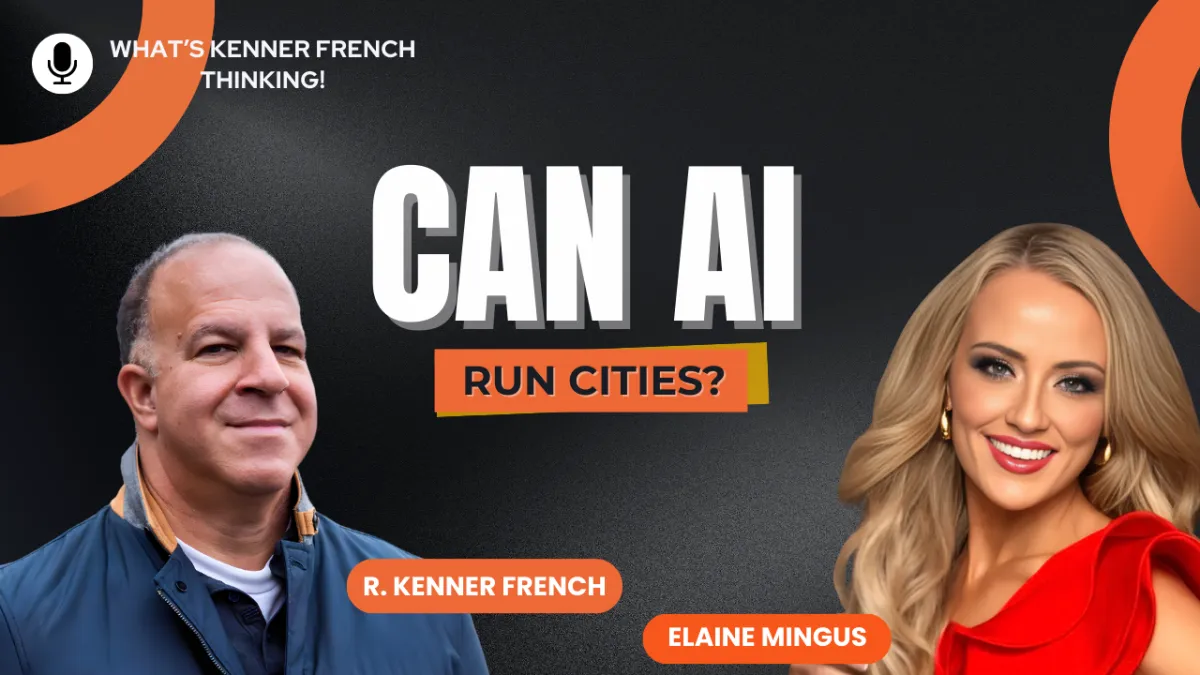
Can AI Run Cities?
Can AI Help Run a City? Bainbridge Island’s Bold Experiment With AI Governance
City governments everywhere are facing the same growing problem: more demands, tighter budgets, slower processes, and rising expectations from citizens who want faster answers and better communication. At the same time, artificial intelligence is rapidly advancing—but most local governments are unsure how, when, or even if they should use it. The fear of security risks, job displacement, and “unknown consequences” often stops progress before it starts ⚠️.
In this episode of What’s Kenner French Thinking,R. Kenner French and host Elaine Mingus explore a timely and provocative idea: introducing artificial intelligence into city government on Bainbridge Island. With the recent retirement of the city manager, Kenner proposes starting with an AI-enabled city manager model—not replacing humans, but enhancing efficiency, communication, and decision-making using ethical and secure AI tools.
The conversation is grounded in real-world use cases, not science fiction. From AI-powered chatbots answering resident questions, to organizing city meeting notes, managing public information, and improving communication through city websites and social media, this episode focuses on practical, incremental adoption. Kenner emphasizes starting small—testing AI on administrative and communication tasks—before expanding into more advanced applications.
They also discuss how other cities are already using AI successfully. Pittsburgh has improved traffic flow using AI-driven systems, while San Francisco is experimenting with AI to identify and repair potholes more efficiently 📈. These examples show that AI isn’t just for tech hubs—it can also benefit smaller communities like Bainbridge Island.
Security and skepticism are addressed head-on. Kenner and Elaine acknowledge concerns, particularly among older populations, but argue that adopting AI responsibly now is safer than waiting a decade and playing catch-up. By building security, ethics, and transparency into AI systems from the beginning, cities can reduce risk while unlocking long-term benefits 🌱.
The episode closes with an invitation to community dialogue, including an upcoming Bainbridge Island meeting to gather public input. Rather than forcing technology on residents, the goal is open conversation, education, and collaboration.
What You’ll Learn
• How AI could support (not replace) city management roles
• Practical AI use cases for local government operations
• Why 2026 is the right time for cities to explore AI adoption
• Real examples of AI use in Pittsburgh and San Francisco
• How AI can improve communication, efficiency, and cost control
• Addressing security, ethics, and public skepticism around AI
Who This Episode Is For
• Bainbridge Island residents and community leaders
• City managers, council members, and public servants
• Anyone curious about AI in government and civic life
• Citizens concerned about efficiency, transparency, and costs
Follow the podcast for future episodes


