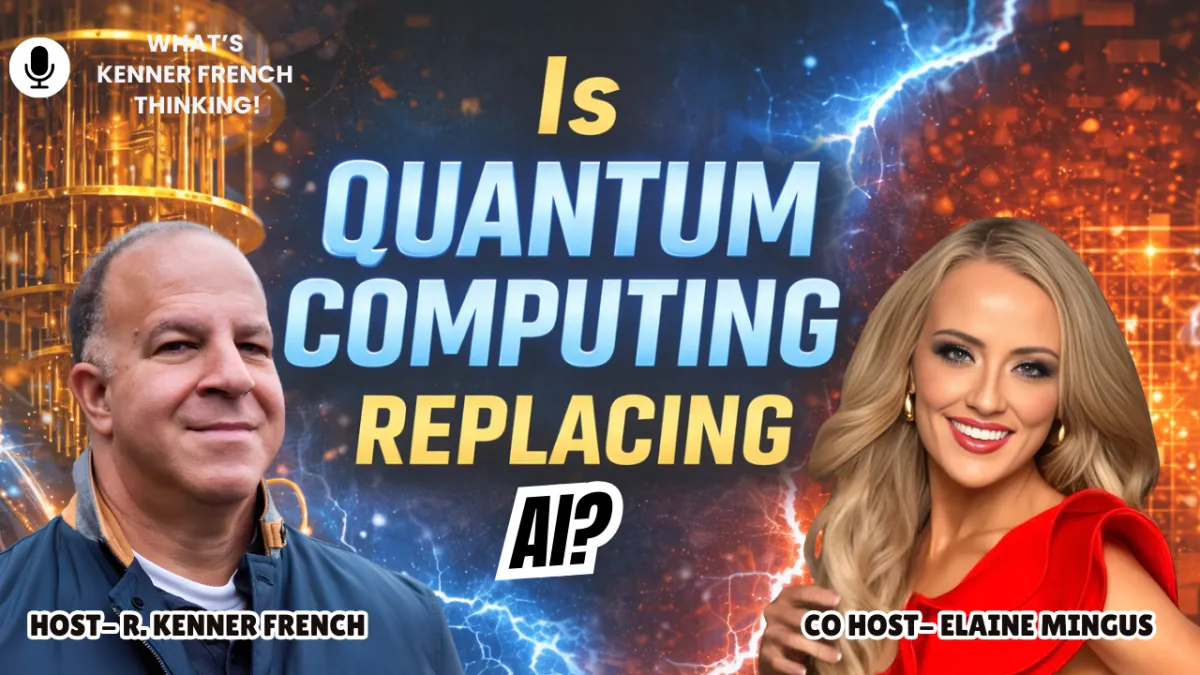
Is Quantum Computing Replacing AI?
Artificial Intelligence is currently the talk of the town, but what happens when the "next big thing" makes AI look like carving on stone? In this episode of What’s Kenner French Thinking, co-host Elaine Mingus sits down with Kenner French, author of the Amazon bestseller ModernMillions.ai, to demystify the complex world of quantum computing.
If your only exposure to "Quantum" is the classic TV show Quantum Leap, you aren't alone. However, the reality of quantum computing is far more powerful—and closer than you might think. Kenner breaks down why this technology is considered the "final step" in hardware evolution and how it differs fundamentally from the binary systems we use today. We explore the staggering potential for quantum computers to process the entire internet in minutes and what this means for medicine, the stock market, and global security.
🎧 What You’ll Learn
Quantum vs. Classical: Why "bits" (1s and 0s) are being replaced by "qubits" that can exist in multiple states simultaneously.
The Speed Gap: How a calculation that takes an AI a week could be finished by a quantum computer in a fraction of a second.
Environmental Impact: Why quantum nodes might actually be more energy-efficient than massive AI data centers.
Global Supremacy: The race between nation-states to achieve quantum supremacy and why security (and your passwords) could be at risk.
Real-World Solutions: The potential for quantum computing to solve "unsolvable" problems, from curing cancer to understanding the Big Bang.
🌱 Who This Episode Is For
This episode is a must-listen for tech enthusiasts, business owners looking toward the 20-year horizon, and anyone concerned about the intersection of cybersecurity and national interest. If you want to understand the infrastructure that will power the next century of human innovation, this conversation is your starting point.
Follow the podcast for future episodes as we continue to track the rapid evolution of AI and beyond.


