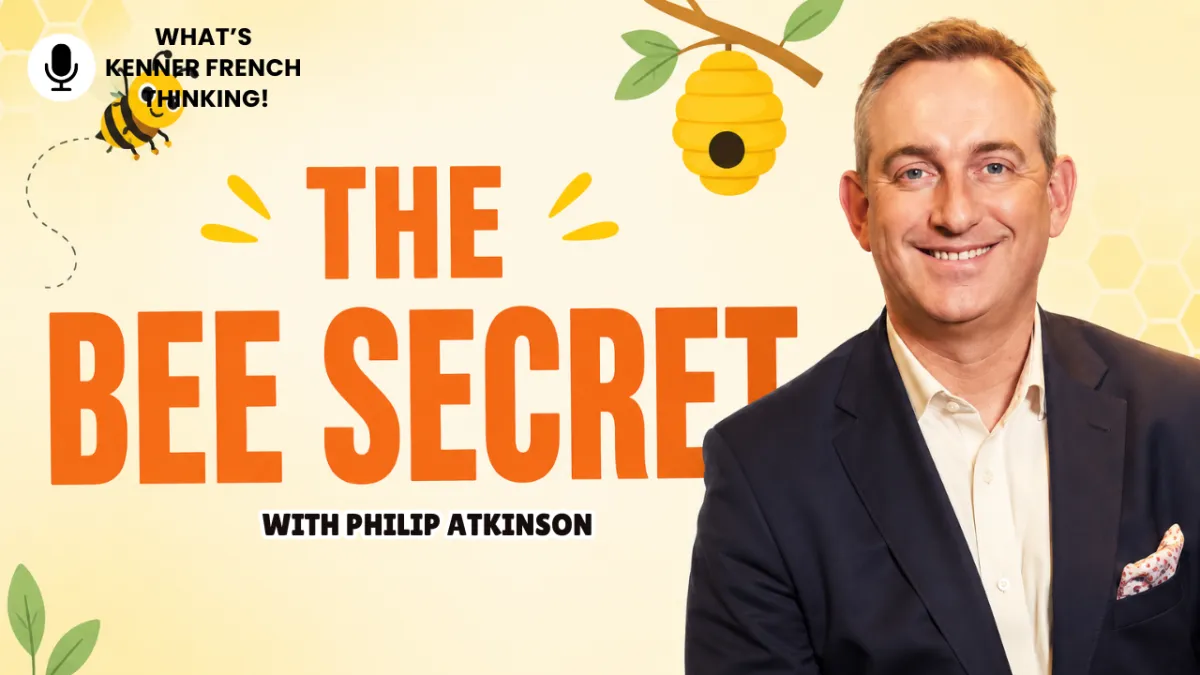
The Bee Secret to Business Growth
For decades, entrepreneurs have been told the same thing:
Work harder.
Wake up earlier.
Stay later.
Outwork everyone else.
Grind harder than the competition.
The business world often glorifies hustle culture. Social media is filled with stories of founders working 18-hour days, sacrificing sleep, skipping vacations, and pushing themselves to the limit in pursuit of success.
But what if that approach is actually holding your business back?
What if the path to sustainable growth isn't about doing more, but about thinking differently?
In a fascinating conversation between entrepreneur Kenner French and Philip Atkinson, author of Bee Wise: 12 Leadership Lessons from a Busy Beehive, listeners are introduced to a surprising source of business wisdom: bees.
At first glance, bees may seem like an unusual place to find leadership lessons. Yet after years of observing bee colonies and working with multinational organizations, Atkinson discovered remarkable similarities between successful businesses and thriving beehives.
His conclusion may surprise many entrepreneurs:
Being busy isn't the goal. Being effective is.
And the difference between those two concepts can determine whether a business grows or stagnates.
The Myth of Being "Busy as a Bee"
The phrase "busy as a bee" has become a badge of honor in modern society.
People proudly announce how busy they are.
Entrepreneurs often wear busyness like a trophy.
But Philip Atkinson challenges this mindset.
During the discussion, he shares an eye-opening fact about worker bees.
A female worker bee spends her life working almost continuously during peak season. She works tirelessly, day after day, until exhaustion eventually takes its toll.
While bees are extraordinary creatures, Atkinson suggests this isn't necessarily a model humans should copy.
Many business owners unknowingly operate exactly like those worker bees.
They spend every day reacting.
Answering emails.
Attending meetings.
Solving immediate problems.
Managing employees.
Handling customer concerns.
Putting out fires.
And by the end of the day, they're exhausted.
Yet despite all that effort, they often feel like they're not making meaningful progress.
The reason is simple.
Activity and achievement are not the same thing.
Being busy doesn't guarantee growth.
Being busy doesn't guarantee innovation.
Being busy doesn't guarantee profitability.
In many cases, constant busyness prevents those things from happening.
Why Entrepreneurs Get Stuck
One of the most valuable insights from the conversation is the idea that busyness creates repetition.
When leaders are constantly moving from task to task, they rarely have time to evaluate what they're doing.
As a result, they repeat the same behaviors.
The same processes.
The same marketing strategies.
The same sales conversations.
The same management style.
The same assumptions.
Year after year.
The problem isn't lack of effort.
The problem is lack of reflection.
Many entrepreneurs believe they need to move faster.
What they actually need is space to think.
Innovation rarely happens when someone is overwhelmed.
Breakthrough ideas usually emerge when leaders pause long enough to examine their business from a new perspective.
The most successful companies in the world aren't simply working harder.
They're learning faster.
They're adapting faster.
They're seeing opportunities others miss.
And those advantages come from thinking—not just doing.
The Hidden Cost of Constant Motion
Modern entrepreneurs live in an environment filled with distractions.
Emails arrive every minute.
Phones never stop buzzing.
Notifications constantly demand attention.
Meetings consume entire days.
Social media competes for focus.
Clients need answers.
Employees need support.
The result is a leadership style driven by reaction rather than intention.
Leaders become so focused on managing the present that they stop preparing for the future.
And when that happens, growth slows.
Businesses begin operating on autopilot.
Teams become less creative.
Customers receive less innovation.
Competitors start gaining ground.
Ironically, the harder entrepreneurs work, the easier it becomes to overlook the very opportunities that could transform their business.
The Competitive Advantage Nobody Is Talking About
During the conversation, Kenner French discusses his company and reflects on what many competitors in his industry fail to do.
The answer wasn't technical expertise.
It wasn't pricing.
It wasn't experience.
It was visibility.
Many businesses remain stuck in old ways of thinking.
They resist new technologies.
They ignore content creation.
They avoid social media.
They fail to educate their audiences.
Meanwhile, businesses willing to adapt create entirely new opportunities.
This reveals a powerful lesson.
Competitive advantages often come from areas that competitors ignore.
Many companies spend enormous resources trying to outperform competitors in crowded spaces.
The smarter strategy is often identifying areas nobody is paying attention to.
Ask yourself:
What customer needs remain unmet?
What questions are people asking?
What frustrations remain unsolved?
What trends are competitors ignoring?
What technologies could improve customer experiences?
The answers to these questions often reveal opportunities hidden in plain sight.
Your Employees Know More Than You Think
One of the strongest themes in Part 1 is the value of employee insights.
Many business owners believe leadership means having all the answers.
Philip Atkinson argues the opposite.
Great leaders ask great questions.
When Kenner describes his team, Atkinson immediately focuses on the people inside the organization.
His point is simple.
The next breakthrough idea may already exist inside the company.
Employees interact with customers every day.
They hear complaints.
They identify inefficiencies.
They notice trends.
They witness frustrations.
They understand problems leaders may never see.
Yet many organizations fail to tap into this knowledge.
Employees are often told what to do rather than asked what they think.
As a result, valuable insights remain hidden.
Innovation stalls.
Opportunities disappear.
Growth slows.
Stop Telling. Start Asking.
Perhaps the most powerful quote from the conversation is also the simplest:
"Stop telling. Start asking."
This principle has the power to transform leadership.
Most organizations operate through instructions.
Managers tell employees what needs to happen.
Leaders provide direction.
Processes dictate behavior.
While direction is important, over-reliance on telling can limit creativity.
Questions create possibilities.
Questions encourage ownership.
Questions stimulate innovation.
Questions uncover ideas.
Imagine regularly asking employees:
What are customers struggling with?
What can we improve?
What are we missing?
What would make your job easier?
What opportunities do you see?
These conversations can reveal insights worth millions of dollars.
Not because leaders suddenly become smarter.
But because they begin leveraging the intelligence already present within their teams.
The Beehive Model of Leadership
Bee colonies succeed because every member contributes.
No single bee creates the success of the hive.
Success emerges from collaboration.
Coordination.
Communication.
Shared purpose.
Businesses operate the same way.
The strongest organizations are not built around one brilliant leader.
They're built around teams that work together effectively.
Leaders who understand this create cultures where people feel heard.
People feel valued.
People feel empowered.
And empowered employees produce extraordinary results.
When employees feel ownership, they become more engaged.
When engagement increases, customer experiences improve.
When customer experiences improve, businesses grow.
The connection is direct.
The Future Belongs to Curious Leaders
At the heart of Philip Atkinson's message is curiosity.
Curious leaders ask questions.
Curious leaders seek new perspectives.
Curious leaders challenge assumptions.
Curious leaders remain open to change.
The business world is evolving faster than ever before.
Technology is changing.
Customer expectations are changing.
Markets are changing.
Industries are changing.
Leaders who remain curious adapt.
Leaders who stop learning fall behind.
The ability to stay curious may become one of the most valuable business skills of the next decade.
Final Thoughts: The Real Bee Secret
The title of this episode suggests there is a secret hidden within the world of bees.
And perhaps there is.
But it isn't about working harder.
It isn't about being busier.
It isn't about sacrificing more.
The real secret is understanding that growth comes from awareness.
Growth comes from reflection.
Growth comes from listening.
Growth comes from asking better questions.
Growth comes from empowering others.
Most entrepreneurs spend years searching for the next strategy that will transform their business.
Yet the answer may already exist inside their organization.
Inside their employees.
Inside their customers.
Inside the conversations they haven't had yet.
The lesson from the bees is surprisingly simple:
Slow down.
Think differently.
Stay curious.
And allow the collective intelligence around you to help build something extraordinary.
Book Your Free Strategy Call Today!
📚 Don’t miss Modern Millions by R. Kenner French – the #1 BEST SELLING Amazon book (Entrepreneurship category)👉ModernMillions.ai
📚 Amazon Top Selling Author→https://www.amazon.com/dp/B0FHBS32LG


