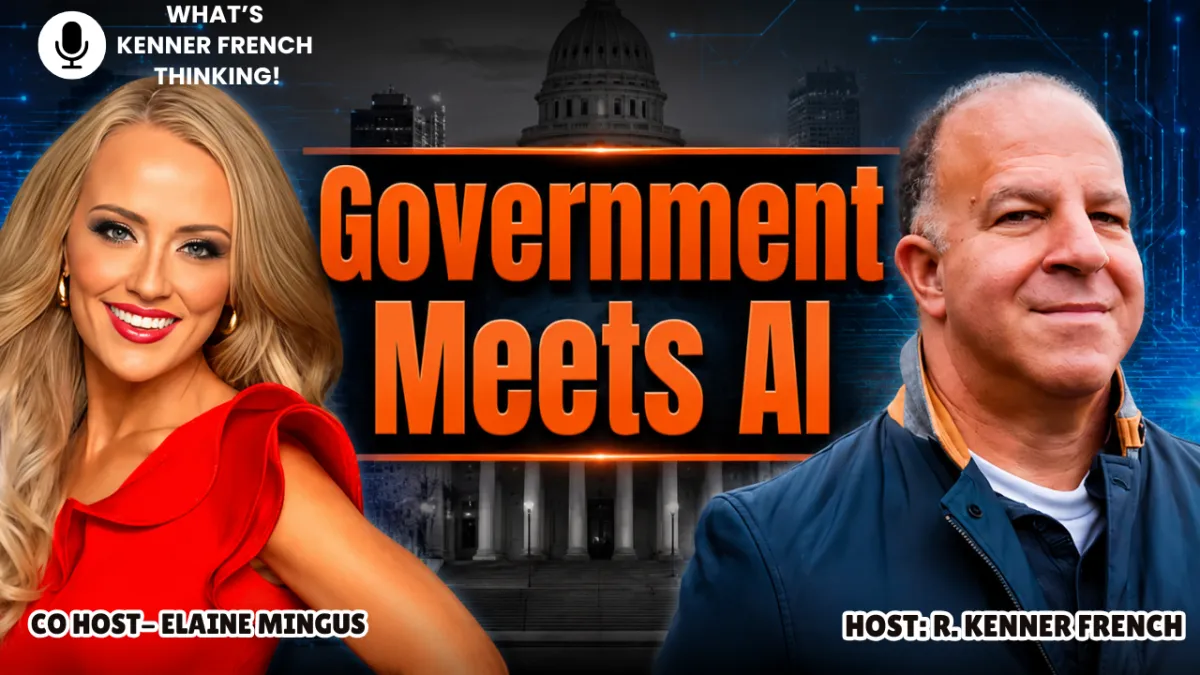
The Future of Government: AI, Hiring & Public Services
Artificial intelligence is no longer a concept reserved for technology companies or research labs. Today, AI is rapidly finding its way into healthcare, finance, education, and businesses of every size. The next major frontier may be government itself.
One of the biggest challenges facing many local governments is efficiency. Hiring key leadership positions can take months—or even years—while administrative tasks continue to pile up. During that time, important decisions involving budgets, public services, and policy implementation may be delayed, affecting the communities these governments serve.
In this conversation, Kenner French shares his vision for how artificial intelligence can help modernize city management—not by replacing people, but by helping government leaders make faster, more informed decisions while improving operational efficiency.
Why Government Hiring Takes So Long
Government hiring is often far more complicated than hiring in the private sector.
Before a city manager or senior administrator is selected, governments typically go through lengthy recruitment processes involving:
Multiple interviews
Public meetings
Candidate evaluations
Committee reviews
Budget discussions
Administrative approvals
These procedures are designed to ensure transparency and accountability. However, they can also create significant delays.
Kenner explains that in some cases, hiring a city manager can take years. During that period, cities may struggle to maintain momentum while waiting for permanent leadership.
His perspective is simple:
Artificial intelligence has the potential to dramatically speed up many parts of this process without eliminating human oversight.
AI Isn't About Replacing Government Leaders
One of the biggest misconceptions about artificial intelligence is that it exists to replace people.
Throughout the discussion, Kenner makes it clear that this is not the goal.
Instead, AI should function as a powerful assistant—helping city managers, councils, and administrators make better-informed decisions while leaving the final judgment to human leaders.
Think of AI as an advanced research assistant that can process enormous amounts of information in seconds rather than days.
That means government officials can spend less time buried in paperwork and more time focusing on leadership, strategic planning, and serving their communities.
What Does a City Manager Actually Do?
Many residents may not fully understand the responsibilities of a city manager.
According to the discussion, a city manager typically oversees:
Implementing city policies
Managing budgets
Coordinating departments
Supporting city council initiatives
Communicating government priorities
Supervising daily administrative operations
These responsibilities involve thousands of routine decisions and repetitive administrative tasks every year.
Artificial intelligence could significantly reduce the workload associated with many of these responsibilities while allowing leaders to focus on higher-level decision-making.
Smarter Budgeting Through Artificial Intelligence 📈
Budget planning is one of the most time-consuming responsibilities for any government.
Every year, cities must balance:
Public safety
Infrastructure
Community programs
Parks and recreation
Employee salaries
Emergency reserves
Long-term capital projects
Traditionally, analyzing this information can require months of manual work.
Kenner argues that AI models can analyze financial data in a fraction of the time, allowing governments to identify trends, compare historical spending, and generate budgeting insights much more efficiently.
Rather than replacing financial experts, AI becomes another tool that supports better financial planning.
Eliminating Repetitive Administrative Work
Not every government task requires complex human judgment.
Many daily activities involve repetitive administrative work such as:
Organizing documents
Preparing reports
Drafting notices
Summarizing meetings
Researching historical policies
Managing internal records
These are precisely the kinds of tasks where AI performs exceptionally well.
By automating routine work, government employees can devote more time to projects that require creativity, collaboration, and community engagement.
AI Can Support Better Decision-Making
Governments collect enormous amounts of information every day.
Unfortunately, valuable data often remains scattered across reports, meeting notes, policy documents, and historical records.
Artificial intelligence can organize and analyze this information much faster than manual research.
Instead of spending hours searching through archives, city officials could retrieve relevant information in seconds.
This doesn't make decisions automatically—it simply gives leaders faster access to the information they need.
Human Judgment Still Matters
An important theme throughout the conversation is that AI should complement—not replace—human leadership.
Elaine Mingus compares AI to a helpful assistant rather than a substitute for parents or decision-makers.
Humans bring qualities that technology cannot fully replicate, including:
Empathy
Experience
Community understanding
Emotional intelligence
Ethical judgment
Artificial intelligence can provide recommendations, organize information, and identify patterns.
People remain responsible for making the final decisions.
Addressing Privacy and Security Concerns 🔒
Whenever artificial intelligence enters public service, questions naturally arise about privacy and security.
The discussion acknowledges that these concerns are legitimate.
Rather than ignoring the risks, governments should carefully evaluate how AI systems are implemented.
Potential safeguards include:
Protected internal databases
Secure local storage
Controlled access to sensitive information
Human review before major decisions
Ongoing oversight and monitoring
Like any technology, responsible implementation is essential.
Every AI System Reflects Human Input
Another interesting topic discussed is bias.
Both humans and AI systems can reflect biases.
However, AI models can be continually refined and adjusted based on local needs and community priorities.
Rather than treating AI as an independent decision-maker, Kenner envisions systems that are trained with local information and guided by human oversight.
This collaborative approach allows governments to benefit from AI while maintaining accountability.
Starting Small Is the Smartest Approach 🌱
Instead of attempting a complete transformation overnight, Kenner recommends introducing AI gradually.
Some practical first steps include:
Taking meeting notes automatically
Drafting public notices
Organizing historical records
Assisting with administrative paperwork
Supporting policy research
Improving budgeting workflows
As government employees become more comfortable with AI, additional applications can be explored responsibly.
A Vision for Smarter Government
Ultimately, the discussion presents a vision of government that is:
More efficient
More responsive
Better informed
More cost-conscious
Better equipped to serve its citizens
Artificial intelligence is not presented as a replacement for public officials.
Instead, it is described as a tool that can help governments operate more effectively while allowing leaders to focus on serving their communities.
Final Thoughts
Artificial intelligence continues to reshape nearly every industry, and government is beginning to explore how these technologies can improve public administration.
While AI cannot replace the leadership, accountability, and judgment of experienced public officials, it has the potential to reduce administrative burdens, accelerate research, improve budgeting, and support faster decision-making.
As cities continue to modernize, the most successful governments may not be those that replace people with technology—but those that thoughtfully combine human leadership with the capabilities of artificial intelligence.
The future of government may not be about choosing between humans and AI. It may be about discovering how both can work together to build stronger, more efficient, and more responsive communities. 🚀
Schedule Your Free Call for Growth Strategies!
📚 Don’t miss Modern Millions by R. Kenner French – the #1 BEST SELLING Amazon book (Entrepreneurship category)👉ModernMillions.ai
📚 Amazon Top Selling Author→https://www.amazon.com/dp/B0FHBS32LG


