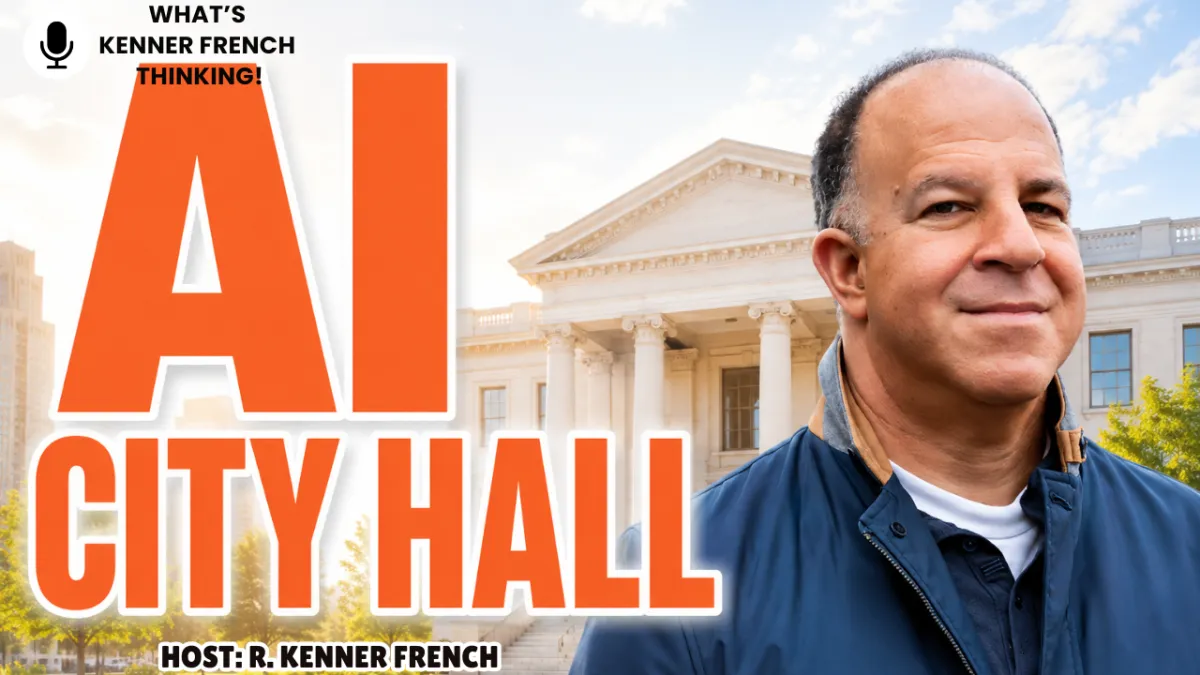
They Want AI Running The City
Artificial intelligence is no longer just a conversation happening inside giant tech companies or Silicon Valley boardrooms.
It’s now entering schools, businesses, hospitals, financial systems — and even local government discussions.
In this part of the conversation, R. Kenner French shares the deeper details behind a community meeting that focused on one major idea:
Could artificial intelligence actually help cities operate more efficiently in the future? 📈
What surprised many people wasn’t just the topic itself.
It was the response.
Instead of fear, resistance, or outrage, the meeting became a productive discussion filled with curiosity, questions, and real conversations about how AI might improve communication, organization, and public access to information inside city government.
And that says something important about where society is heading.
The Conversation Around AI Is Changing 🌍
For years, artificial intelligence has been treated like a futuristic concept that belonged only in movies or technology labs.
But now, people are starting to realize that AI is already deeply connected to everyday life.
Most people interact with artificial intelligence daily without even noticing it.
Every time someone:
Uses Google Search
Opens social media
Talks to a virtual assistant
Uses facial recognition
Receives online recommendations
Uses smart home devices
Navigates with GPS
…they are already interacting with AI systems in some way. 📱
That realization became one of the key themes throughout the discussion.
Artificial intelligence is no longer “coming someday.”
In many ways, it’s already here.
Why The Meeting Surprised Everyone 🤯
Kenner openly admitted that he expected much more pushback from the community.
With topics like AI in government, many people assume the reaction will immediately turn negative or emotional.
But instead of chaos, the meeting became constructive.
Residents, professionals, and attendees from even outside Bainbridge Island joined the discussion to explore practical ways artificial intelligence could support local government operations.
One of the biggest discoveries was realizing how many AI-oriented individuals already exist within the community.
Some attendees were beginners simply curious about AI tools like ChatGPT.
Others were experienced professionals who had spent years working directly in technology and artificial intelligence systems.
That combination created something powerful:
a collaborative learning environment. 🧠
Starting Small Instead of Moving Too Fast ⚠️
One of the smartest ideas discussed during the meeting was the importance of gradual adoption.
Rather than jumping fully into AI-powered government systems overnight, the group agreed that cities should begin with smaller and safer applications first.
Kenner described it as:
“Putting a toe in the water.”
That means using artificial intelligence in areas where it can provide immediate value without replacing human decision-making.
Some examples discussed included:
Improving city communication
Managing social media updates
Organizing public information
Streamlining workflows
Helping citizens access updates faster
Assisting administrative efficiency
The focus was not on removing humans from leadership.
The focus was on helping systems work better. 📊
The Communication Problem Inside Many Cities 🏛️
One of the major concerns brought up during the meeting was the growing disconnect between city leadership and local citizens.
Many residents often feel:
uninformed,
disconnected,
or unaware of important city decisions and updates.
Even when information is technically public, it can still be difficult for people to find, understand, or access quickly.
This is where artificial intelligence could potentially help.
AI-powered systems can:
organize information faster,
summarize updates,
distribute announcements,
improve social media communication,
and make public information easier to understand.
Instead of waiting for people to search through long documents or government websites, AI tools could help deliver clearer communication directly to citizens. 📢
And in today’s digital world, communication speed matters more than ever.
Ethical Concerns Still Matter 🌱
Of course, not everyone sees artificial intelligence positively.
And the meeting did not ignore those concerns.
Kenner openly discussed some of the biggest worries surrounding AI, including:
ethics,
privacy,
transparency,
environmental impact,
and responsible oversight.
One major topic was energy consumption.
Artificial intelligence systems require massive amounts of computing power, which means they also consume significant energy resources. ⚡
That raises understandable environmental concerns.
However, Kenner also pointed out that the technology industry continues developing more efficient systems designed to reduce AI’s environmental footprint over time.
Rather than pretending the concerns don’t exist, the meeting focused on finding balanced solutions.
That may ultimately become one of the most important conversations surrounding AI in the coming years:
How do we responsibly adopt powerful technology while still protecting people and communities?
AI Is Not The Entire Solution 🚀
Another important takeaway from the discussion was that AI should not be viewed as some magical answer to every problem.
Artificial intelligence is simply one tool.
A powerful tool — but still just one piece of a much larger system.
Kenner explained that there are many ways cities can improve in the future, and AI may simply help support those improvements.
The future will likely belong to communities that learn how to combine:
human leadership,
technology,
communication,
and innovation together.
Not communities that blindly reject change.
And not communities that blindly trust technology either.
Balance will matter.
Building An AI Community 🤝
One of the most exciting outcomes from the meeting was the decision to continue the conversation through monthly workshops and gatherings.
The goal is to create a space where:
beginners can learn,
professionals can share ideas,
residents can ask questions,
and communities can better understand the future of AI together.
That may end up being one of the biggest long-term benefits:
education.
Because whether people love AI or fear it, understanding it will become increasingly important in the years ahead.
Communities that learn early may ultimately adapt faster than communities that ignore the conversation completely.
The Bigger Picture 📈
This discussion was never really just about one city manager position.
It represents something much bigger.
It represents the beginning of a larger societal shift where artificial intelligence slowly becomes part of everyday decision-making, business operations, communication systems, and public services.
Some communities will resist it.
Others will experiment carefully.
But one thing is becoming increasingly clear:
The conversation about AI is no longer optional.
It has already started. 🤖
Book Your Free Strategy Call Today!
📚 Don’t miss Modern Millions by R. Kenner French – the #1 BEST SELLING Amazon book (Entrepreneurship category)👉ModernMillions.ai
📚 Amazon Top Selling Author→https://www.amazon.com/dp/B0FHBS32LG


