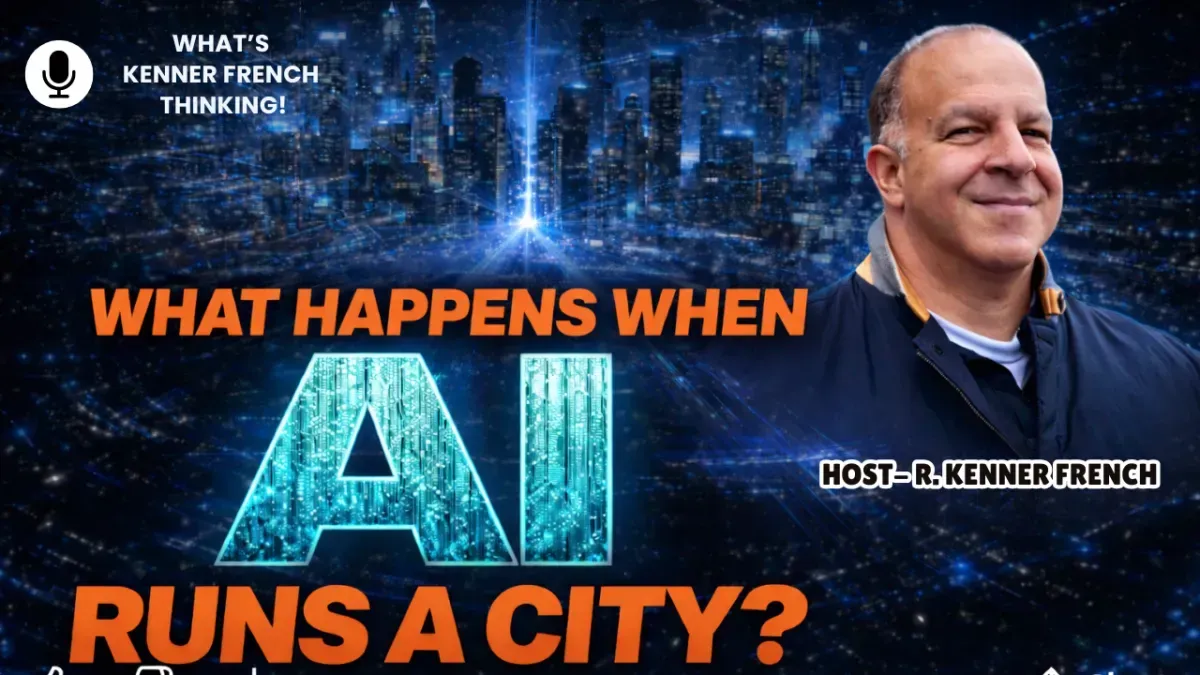
What Happens When AI Runs a City?
Most city governments today still operate like it’s decades ago.
Slow approvals.
Manual processes.
Layers of bureaucracy that delay even the simplest decisions.
Now imagine this:
👉 A city that thinks in real-time
👉 A system that never sleeps
👉 Decisions powered by data—not politics
This isn’t science fiction anymore.
It’s already being discussed—and in some cases, tested.
⚠️ The Real Problem: Cities Are Too Slow
One of the biggest challenges cities face today is leadership bottlenecks.
Hiring a city manager alone can take years, leaving critical decisions stuck in limbo.
During that time:
Budgets stall
Infrastructure projects delay
Public services suffer
And while governments slow down…
👉 Citizen expectations speed up.
People now expect:
Instant responses
Real-time updates
Digital-first services
But most cities simply aren’t built for that level of demand.
🤖 The Big Idea: AI as the City’s Operating System
Instead of fixing broken systems piece by piece…
What if you replaced the entire operating layer?
That’s the idea behind an AI-powered city manager—a system designed to act as a “Chief Operating System” for the city.
Not to replace humans—
But to supercharge them.
🚀 What AI Can Actually Do for a City (Right Now)
This isn’t futuristic theory—it’s already happening.
1. 📊 Real-Time Budgeting & Financial Decisions
AI can process complex municipal budgets in hours instead of months.
Optimize spending
Reduce waste
Identify inefficiencies instantly
👉 Result: Lower taxes, better allocation
2. 💬 24/7 Citizen Communication
AI systems can respond instantly to:
Permit questions
Public service requests
Local updates
No waiting. No backlogs.
Just answers.
3. 🚦 Smart Infrastructure & Traffic Control
Cities are already using AI to:
Predict traffic congestion
Prevent accidents
Optimize traffic lights
👉 Some systems even respond before problems happen
4. 🗑️ Automated City Operations
AI can manage:
Waste collection routes
Energy distribution
Maintenance schedules
In some advanced models, entire city systems are automated and optimized in real-time.
5. 🔮 Predictive Urban Planning
Instead of guessing…
AI can simulate:
Housing developments
Traffic flow
Economic impact
👉 Cities can see the future before making decisions.
⚖️ The Advantage: Speed, Efficiency, and Less Bias
One of the biggest promises of AI governance is removing human inefficiencies.
No emotional decision-making
No political bias (in theory)
No delays from internal conflicts
AI doesn’t care about opinions.
It cares about optimization.
And that changes everything.
🚨 But Here’s the Catch (And It’s Important)
Before you fully buy into the idea…
There are real concerns.
🔒 Privacy
AI requires massive amounts of data.
That means:
Surveillance risks
Data misuse concerns
Security vulnerabilities
⚖️ Ethics
Who decides what the AI prioritizes?
Efficiency?
Fairness?
Profit?
Equality?
Because the algorithm reflects whoever built it.
👥 Human Judgment Still Matters
Cities are not just systems.
They are communities.
AI can analyze data…
But it can’t fully understand:
Culture
Values
Human emotion
👉 That’s why AI should assist—not replace—leaders.
🧠 The Bigger Shift: From Smart Cities to “Thinking Cities”
We’re moving beyond smart cities (data collection)…
Into something bigger:
👉 Cognitive Cities
Cities that:
Think
Learn
Adapt
Act in real-time
From traffic to taxes…
Everything becomes dynamic.
💡 The Real Question Isn’t “Can AI Run a City?”
Because it already can.
The real question is:
👉 Can your city afford NOT to use it?
Cities that adopt AI early will:
Operate faster
Spend smarter
Serve people better
And cities that don’t?
They risk falling behind—fast.
🎯 Final Thoughts
AI running a city doesn’t mean removing humans.
It means removing friction.
It means:
Faster decisions
Smarter systems
Better outcomes
The future of cities won’t be built on more bureaucracy…
It will be built on better intelligence.
And that shift?
It’s already happening.
Book Your Free Strategy Call Today!
📚 Don’t miss Modern Millions by R. Kenner French – the #1 BEST SELLING Amazon book (Entrepreneurship category)👉ModernMillions.ai
📚 Amazon Top Selling Author→https://www.amazon.com/dp/B0FHBS32LG


