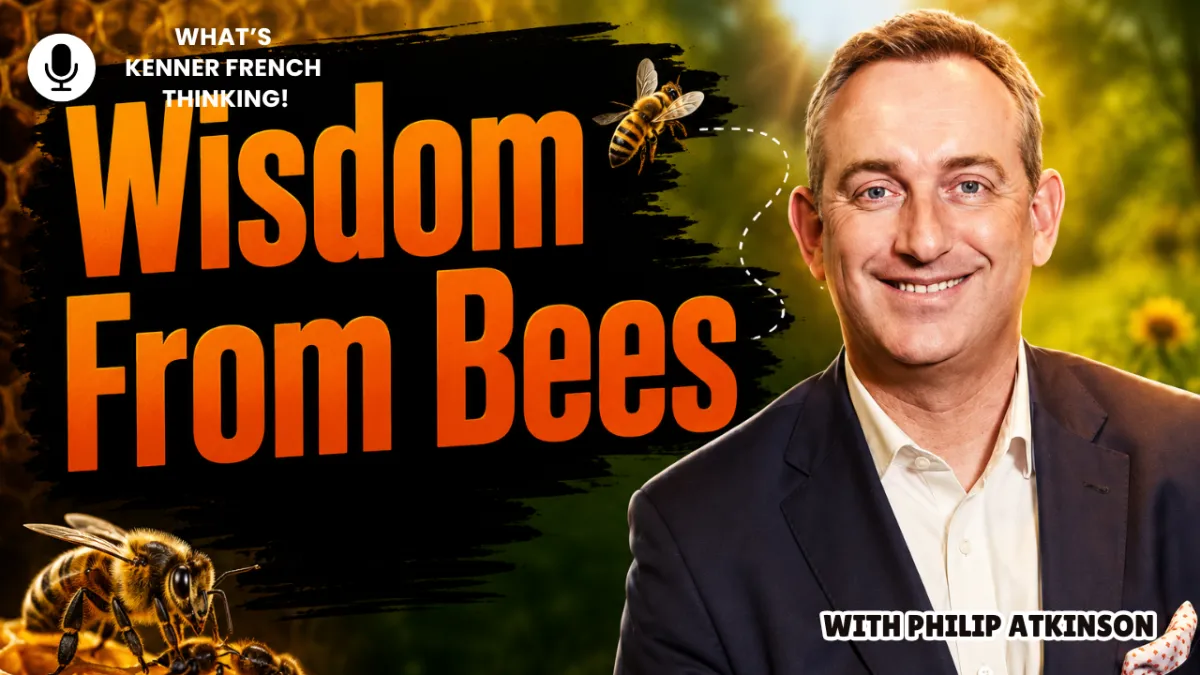
Wisdom From Bees: What Bees Can Teach Business Leaders About Success, Burnout, and Growth
In today's fast-moving business world, entrepreneurs are constantly encouraged to start something new.
Launch a new product.
Attend another networking event.
Join another mastermind.
Pursue another opportunity.
While innovation and growth are essential, there is one critical leadership skill that often gets overlooked: learning how to close things well.
This powerful lesson comes from an unexpected source—the humble honeybee.
In a recent conversation, leadership expert and author Philip Atkinson shared how years of beekeeping inspired valuable insights about leadership, business growth, productivity, and personal development. What began as a hobby eventually revealed lessons that apply to entrepreneurs, business owners, managers, and professionals everywhere.
His message is simple yet profound:
Everything in life has a cycle.
And success often depends on how well we complete that cycle.
🌱 The Natural Cycle of Success
According to Philip, bees live according to natural seasons.
Spring.
Summer.
Autumn.
Winter.
Each season serves a purpose and contributes to the health of the hive.
The same principle applies to business and life.
Every project, initiative, relationship, meeting, or career opportunity follows a cycle:
A beginning
A middle
An end
Most people love beginnings.
Starting a new business is exciting.
Launching a new product creates energy.
Signing a new client generates enthusiasm.
Beginning something new often feels rewarding because it is filled with possibility.
However, where many individuals and organizations struggle is at the end of the cycle.
The closing phase rarely receives the same level of attention.
Yet it may be the most important stage of all.
📈 Why Leaders Should Pay More Attention to Endings
One of the most valuable insights Philip shared is that organizations often rush from one opportunity to another without taking time to reflect.
Projects finish.
Clients leave.
Meetings end.
Initiatives conclude.
And everyone immediately moves on to the next priority.
Unfortunately, this creates missed opportunities for learning and growth.
When leaders fail to close things intentionally, important questions often go unanswered:
What worked well?
What could have been improved?
What lessons should be carried forward?
What should be done differently next time?
What value was created during the process?
Without answering these questions, organizations risk repeating the same mistakes over and over again.
Growth becomes harder because learning never becomes part of the process.
⚠️ The Hidden Cost of Never Closing Things
Many business owners believe burnout comes solely from working too many hours.
While workload certainly plays a role, Philip suggests another contributor.
Open loops.
Unfinished conversations.
Unresolved projects.
Incomplete meetings.
Lack of closure creates mental clutter.
Imagine having dozens of applications running on your computer simultaneously.
Each one consumes energy and resources.
Eventually, the system slows down.
The same thing happens to people.
When projects remain emotionally or mentally unfinished, they continue occupying space in our minds.
Over time this can lead to:
Stress
Frustration
Reduced focus
Lower productivity
Burnout
Closing things properly allows people to release mental energy and move forward with clarity.
🎯 The Importance of Closing Meetings Well
One example Philip highlights is meetings.
Most organizations focus heavily on agendas and discussions.
Very few focus on endings.
Think about how many meetings conclude:
The clock runs out.
People leave early.
The Zoom call abruptly ends.
Everyone rushes off to their next task.
But what happens when a meeting ends without proper closure?
Confusion.
Misalignment.
Unclear expectations.
Missed opportunities.
Instead, Philip recommends intentionally reserving a few minutes at the end of every meeting to review key points.
Ask questions like:
Is everyone aligned?
Have we made the necessary decisions?
What did we learn?
What actions need to happen next?
Is anything still unresolved?
Those final few moments can dramatically improve communication and execution.
🚀 Masterminds, Networking, and Missed Opportunities
The discussion also explored a challenge many entrepreneurs face after attending networking events and mastermind groups.
These experiences often generate:
New ideas
New partnerships
New opportunities
New business relationships
The excitement can be overwhelming.
However, many business owners make the same mistake.
They immediately move on to the next event.
The next conference.
The next mastermind.
The next opportunity.
As a result, valuable insights and connections are never fully developed.
The investment of time and money produces limited results because there was no intentional process for reviewing, implementing, and closing the experience.
The lesson?
Slow down long enough to extract the value before chasing the next opportunity.
🧠 Why Slowing Down Creates Better Results
One particularly powerful moment in the conversation occurred when Philip intentionally slowed down his speech.
The effect was noticeable.
The message became more impactful.
Listeners became more attentive.
That moment reinforced another important leadership lesson.
Speed is not always an advantage.
In many situations, slowing down creates space for reflection, understanding, and better decision-making.
Modern business culture often celebrates constant motion.
But wisdom frequently emerges during moments of pause.
When leaders create space to reflect, they gain clarity that would otherwise be lost in the noise.
🐝 How Beekeeping Inspired a Leadership Book
Interestingly, Philip never intended for beekeeping to become a business lesson.
In fact, it started as something completely unrelated to work.
He wanted a hobby.
A way to disconnect.
A way to step away from business responsibilities.
Then one day, while observing activity around his workplace, he noticed something remarkable.
The patterns he observed inside organizations mirrored the patterns he saw inside the hive.
The metaphors became impossible to ignore.
Over time, he began sharing these observations through stories and reflections.
Every Friday became "Hive Day" on LinkedIn, where he would share lessons inspired by the bees.
The response was overwhelmingly positive.
People wanted more stories.
More insights.
More lessons.
Eventually, those stories became the foundation for his book, Be Wise.
❤️ A Book with a Bigger Purpose
One of the most inspiring aspects of Philip's project is that every dollar generated by the book goes to charity.
Not some of the proceeds.
Not a percentage.
All proceeds.
The book became an opportunity to:
Share meaningful stories
Encourage reflection
Help people grow
Support charitable causes
It's a reminder that success can be measured by impact as much as income.
🌟 Final Thoughts
The greatest lesson from the bees may not be about productivity or hard work.
It may be about completion.
In a world obsessed with beginnings, we often underestimate the power of endings.
Projects deserve thoughtful conclusions.
Meetings deserve proper closure.
Client relationships deserve reflection.
Life itself follows cycles that deserve acknowledgment.
When we learn to close things well, we create space for learning, growth, and stronger beginnings.
Perhaps the wisdom of the hive is simpler than we think.
Slow down.
Reflect.
Learn.
And before rushing into the next opportunity, take a moment to close the current one well.
Because sometimes the most valuable lessons are found at the end. 🐝✨
Book Your Free Strategy Call Today!
📚 Don’t miss Modern Millions by R. Kenner French – the #1 BEST SELLING Amazon book (Entrepreneurship category)👉ModernMillions.ai
📚 Amazon Top Selling Author→https://www.amazon.com/dp/B0FHBS32LG


