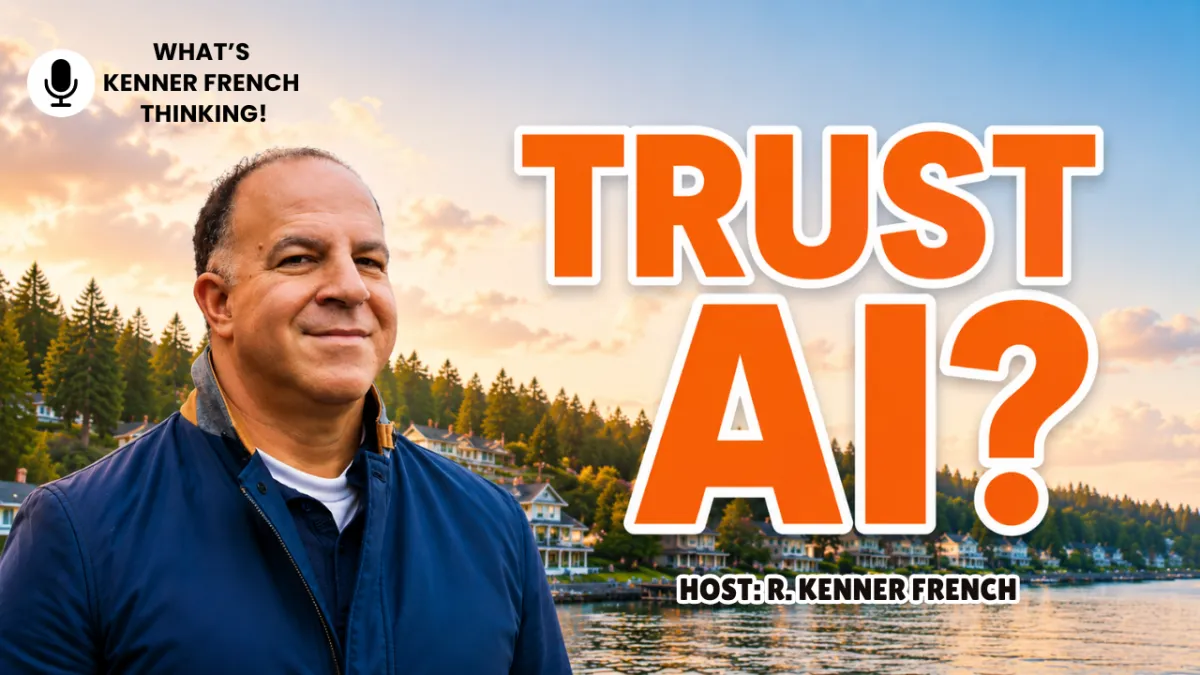
Would You Trust an AI City Manager?
Artificial intelligence is no longer just a tool for tech companies, global corporations, or Silicon Valley startups 💻🌎. Today, AI is beginning to enter one of the most important parts of everyday life — local government 🏛️.
Recently, an exciting discussion took place surrounding a bold and innovative idea: the possibility of an AI-oriented city manager for Bainbridge Island 🌉. What started as a conversation quickly turned into something much bigger 📈. Community members, business professionals, technology enthusiasts, and people from outside the state gathered together to discuss one important question:
❓ Can artificial intelligence actually help run a city more effectively?
Surprisingly, the answer from many attendees was YES ✅.
🌟 The Birth of the “AI City Manager” Concept
The idea was introduced by entrepreneur and AI advocate Kenner French 👨💼, founder of VastSolutionsGroup.com and author of the bestselling book Modern Millions.ai 📚.
Instead of relying solely on traditional management systems, the proposal explored how AI tools could support city leadership, improve efficiency ⚡, strengthen communication 📢, and help government operate more transparently 🔍.
The proposed AI model, nicknamed “Joel” 🤖, wasn’t designed to replace humans entirely. Instead, the concept focuses on creating an AI-oriented leadership system capable of assisting city officials with:
📊 Data analysis
💬 Citizen communication
⚙️ Workflow optimization
📰 Public information distribution
At first glance, many people may assume this idea sounds futuristic 🚀 or even controversial 😮. However, the meeting revealed something unexpected:
💡 There is already strong public interest in integrating artificial intelligence into local government.
🧠 Why Communities Are Becoming Open to AI Leadership
One of the most interesting takeaways from the discussion was how knowledgeable many residents already are about artificial intelligence 🤓.
AI is no longer a niche topic. Over the past few years, tools like ChatGPT, automated systems, AI-driven customer service, and machine learning platforms have become part of everyday life 📱💻.
Businesses use AI for:
📈 Marketing
🤝 Customer support
💰 Accounting
🚚 Logistics
🎨 Creative work
So naturally, people are beginning to ask:
🤔 “If AI can improve businesses, why can’t it improve city government too?”
This question sparked meaningful conversations during the meeting 🗣️. Instead of rejecting the idea outright, attendees began discussing practical ways AI could assist the city without removing the human element entirely ❤️.
📢 The Biggest Problem: Communication
One issue consistently mentioned during the conversation was the lack of communication between local government and citizens 🏛️➡️👥.
Many residents feel disconnected from:
📣 Important updates
🛠️ City projects
📜 Public announcements
🗳️ Policy decisions
Even though social media platforms and digital communication tools exist 🌐, information often fails to reach the community effectively.
Artificial intelligence could potentially change that ⚡.
Imagine a city system capable of:
⏰ Instantly answering citizen questions 24/7
🌍 Translating information into multiple languages
📝 Summarizing city council meetings automatically
📲 Sending customized updates to residents
📂 Managing public records more efficiently
📈 Monitoring community concerns in real time
🚨 Improving emergency communication systems
Rather than replacing city employees, AI could serve as a powerful assistant 🤝 that helps government become faster, clearer, and more responsive.
⚡ Could AI Make Government More Efficient?
Efficiency was another major topic during the discussion 📊.
Local governments often struggle with:
🐌 Slow administrative processes
👥 Staff shortages
💸 Increasing operational costs
⏳ Delayed public responses
📚 Information overload
AI systems excel at:
🔄 Handling repetitive tasks
📑 Organizing data
⚙️ Streamlining communication
This allows human workers to focus on more strategic, creative, and people-centered responsibilities ❤️.
For example, AI could assist with:
🏗️ Permit processing
💵 Budget analysis
🛣️ Infrastructure monitoring
📅 Scheduling and logistics
📋 Data reporting
🧾 Public service management
In many industries, AI has already dramatically improved productivity 📈.
The question now is whether municipalities are ready to embrace similar changes 🤔.
⚖️ Fear vs Opportunity
Whenever new technology emerges, fear naturally follows 😟.
Some people worry about:
🤖 Job replacement
🔒 Privacy concerns
⚠️ Over-reliance on technology
🧠 Ethical risks
🚫 Loss of human decision-making
These concerns are valid and deserve serious discussion 💬.
However, supporters of AI integration argue that refusing to explore innovation may create even bigger problems in the future 🌎.
Cities that adapt early may become:
🚀 More competitive
⚡ More efficient
🏡 More attractive to residents and businesses
The goal is not to hand full control to machines ❌🤖.
The goal is to create smarter systems where humans and AI work together 🤝✨.
🌍 A Community-Driven Movement
One of the most inspiring outcomes from the meeting was the decision to continue gathering regularly to explore AI solutions for the community 👥.
The group plans to hold ongoing workshops and discussions focused on:
🎓 AI education
⚙️ Government efficiency
📢 Community engagement
💻 Technology implementation
🛡️ Ethical AI usage
🏙️ Future city planning
This transforms the idea from a single conversation into a long-term collaborative initiative 🌱.
Instead of waiting for large governments or corporations to lead the AI revolution, local citizens themselves are beginning to take initiative 💪.
That may be one of the most important lessons from this entire movement 🌟.
🏙️ Small Cities Could Lead the Future
Ironically, smaller communities may be in the best position to experiment with AI innovation 🤖.
Large cities often face:
🏢 Bureaucratic complexity
🐢 Political gridlock
🌐 Massive operational systems
⏳ Slow adaptation cycles
Smaller cities and communities can move faster ⚡, test ideas more quickly 🧪, and build stronger relationships with citizens ❤️.
This creates a unique opportunity:
🚀 Small cities could become pioneers in AI-powered governance.
If successful, these experiments could eventually influence larger municipalities across the country 🇺🇸🌎.
📚 The Role of Education in AI Adoption
Another major realization from the meeting was that education will play a critical role moving forward 🎓.
Many people still misunderstand artificial intelligence 🤷.
Some imagine science fiction scenarios 👽, while others underestimate its capabilities entirely 😅.
The reality is somewhere in between ⚖️.
AI is simply a tool — a very powerful tool 🔧🤖.
Like any tool, its impact depends on how humans choose to use it 👥.
That’s why community education, transparency, and responsible implementation are essential 🔍.
Citizens must understand:
📖 What AI is
⚙️ What AI can do
🚫 What AI cannot do
🧠 How decisions are made
🔒 How data is protected
Without public trust, even the best AI systems will fail ❌.
🔮 The Future Has Already Started
The idea of an AI city manager may sound futuristic today 🚀, but history shows that every major technological shift once sounded impossible.
There was a time when:
💳 Online banking sounded risky
📱 Smartphones seemed unnecessary
🏠 Remote work appeared unrealistic
🌐 Social media looked insignificant
Today, all of those technologies shape everyday life 🌎.
Artificial intelligence is following the same path 🤖.
The real question is no longer:
❓ “Will AI become part of government?”
The real question is:
🚀 “Which communities will adapt first?”
✨ Final Thoughts
The Bainbridge Island discussion may eventually be remembered as more than just a local meeting 🏛️.
It could represent an early glimpse into the future of public leadership 🔮.
AI will not solve every problem ❌.
It will not replace human wisdom, compassion, or ethical judgment ❤️.
But it can become an incredibly powerful partner 🤝.
Communities willing to embrace innovation thoughtfully may unlock new levels of:
⚡ Efficiency
🔍 Transparency
📢 Public engagement
…that were once impossible.
🤖 The future of government may not be fully artificial.
🌟 But it will almost certainly be AI-assisted.
And that future may already be beginning 🚀
Book Your Free Strategy Call Today!
📚 Don’t miss Modern Millions by R. Kenner French – the #1 BEST SELLING Amazon book (Entrepreneurship category)👉ModernMillions.ai
📚 Amazon Top Selling Author→https://www.amazon.com/dp/B0FHBS32LG


