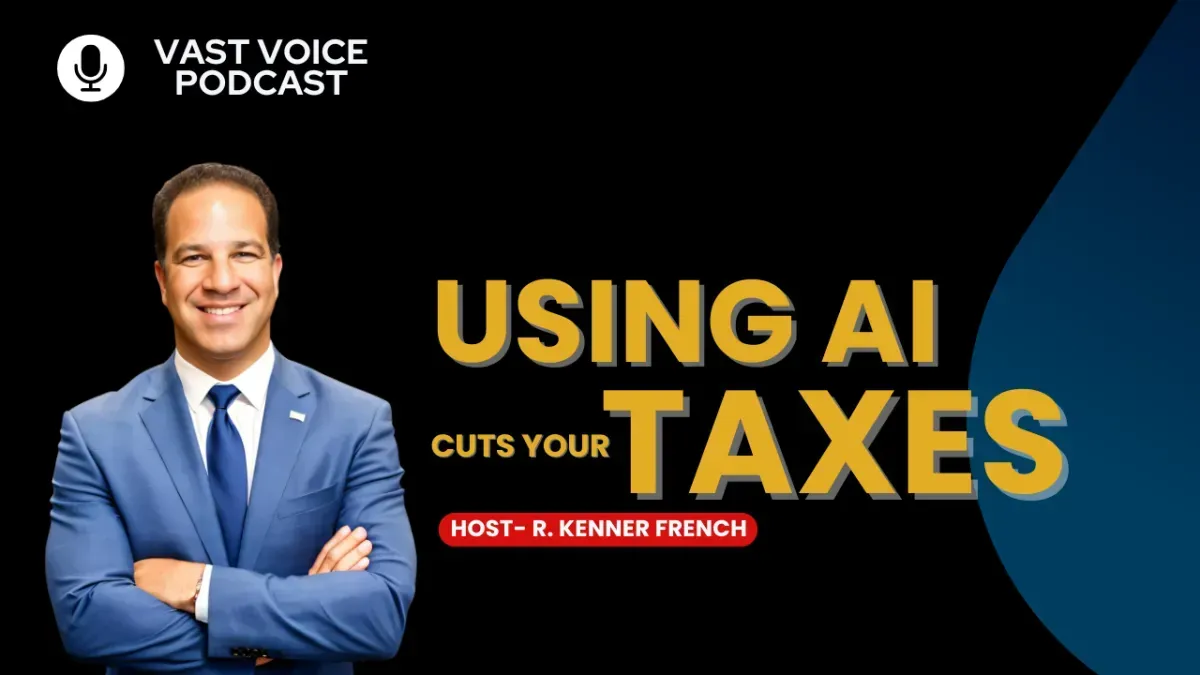
Using AI Cuts Your Taxes!
Taxes are one of the largest expenses business owners face — yet most entrepreneurs spend more time trying to increase revenue than optimizing their tax strategy.
What if the key to keeping more of what you earn isn’t just hiring a CPA — but leveraging Artificial Intelligence the right way?
In the episode “Using AI Cuts Your Taxes,” the conversation explores how AI isn’t just a buzzword — it’s becoming a serious tool for smarter financial management and strategic tax planning.
Let’s break down how this works and why it matters.
💡 The Big Idea: AI as a Tax Strategy Multiplier
Artificial Intelligence doesn’t replace your CPA.
It enhances your decision-making.
AI tools can:
Analyze expenses faster
Identify deduction patterns
Flag inconsistencies
Categorize transactions automatically
Run tax scenario simulations
Assist with compliance tracking
Instead of reacting to tax season in March or April, AI allows business owners to be proactive year-round.
And proactive strategy is where real savings live.
📊 From Reactive to Predictive Tax Planning
Traditional tax planning is backward-looking.
You hand your accountant last year’s numbers.
They tell you what you owe.
AI flips that script.
With the right systems in place, you can:
Forecast tax liability in real time
Model “What if?” scenarios
See the impact of hiring, investing, or expanding
Evaluate entity structure decisions
Track quarterly estimated payments dynamically
Instead of guessing, you’re operating with data-backed clarity.
That’s not just convenience — that’s financial power.
🧾 Expense Categorization: Where AI Shines
One of the biggest leaks in small business tax strategy?
Poor expense tracking.
Many entrepreneurs:
Miss deductions
Misclassify transactions
Overlook legitimate write-offs
Underutilize business credits
AI-driven bookkeeping tools can:
Automatically categorize transactions
Learn patterns from past behavior
Suggest optimized classifications
Highlight unusual spending
This improves:
✔ Accuracy
✔ Compliance
✔ Deduction capture
✔ Financial visibility
Small improvements in categorization can mean thousands saved annually.
🏢 Smarter Entity & Structure Decisions
Should you operate as:
Sole proprietor?
LLC?
S-Corp?
C-Corp?
AI tools can simulate projected tax outcomes under different structures based on:
Revenue growth
Payroll
Distributions
Profit margins
While final decisions should involve a licensed professional, AI dramatically shortens the research cycle and helps entrepreneurs ask better questions.
And better questions lead to better tax outcomes.
📈 Real-Time Cash Flow Awareness
Cash flow and taxes are deeply connected.
AI-powered dashboards can:
Monitor income trends
Flag quarterly payment shortfalls
Track deductible expenses
Alert you before compliance issues arise
This prevents surprises.
And in business, eliminating surprises reduces stress — and financial mistakes.
⚠️ Important: AI Is a Tool, Not a Substitute
The episode makes a critical distinction:
AI does not replace human expertise.
It supports:
CPAs
Tax strategists
Financial advisors
Think of AI as:
A calculator on steroids
A data analyzer that never sleeps
A compliance assistant
A forecasting engine
But strategic interpretation and legal advice must still come from licensed professionals.
Used correctly, AI becomes a force multiplier.
Used blindly, it becomes risky.
🧠 Strategic Mindset Shift
The deeper lesson from the conversation isn’t just about software.
It’s about mindset.
High-level entrepreneurs don’t ask:
“How do I pay less tax?”
They ask:
“How do I structure my operations intelligently so tax efficiency happens naturally?”
AI supports:
Smarter structuring
Better forecasting
Stronger documentation
Improved financial discipline
And that creates long-term tax efficiency.
🔍 Where AI Creates the Biggest Tax Impact
Here are the biggest areas where AI can reduce tax friction:
1️⃣ Expense tracking & deduction capture
2️⃣ Entity modeling & structural optimization
3️⃣ Real-time profit forecasting
4️⃣ Compliance reminders
5️⃣ Payroll and contractor tracking
6️⃣ Multi-entity bookkeeping support
7️⃣ Tax credit identification
When combined, these tools create compounding savings.
🚀 The Competitive Edge
Entrepreneurs who leverage AI gain:
Faster financial insight
Better tax preparation
Lower compliance risk
Improved strategic planning
More confidence in decision-making
In competitive industries, small margins matter.
And taxes directly impact margins.
AI doesn’t just save time — it improves financial intelligence.
💬 Final Takeaway
Using AI to cut your taxes isn’t about shortcuts.
It’s about:
Smarter systems
Better visibility
Proactive planning
Stronger decision-making
Entrepreneurs who embrace AI strategically position themselves to:
✔ Keep more of what they earn
✔ Reduce unnecessary tax exposure
✔ Scale with financial clarity
In today’s business environment, AI isn’t optional — it’s becoming foundational.
And when used properly, it turns tax season from a stressful event into a strategic advantage.
Schedule Your Free Call for Growth Strategies!
📚 Don’t miss Modern Millions by R. Kenner French – the #1 BEST SELLING Amazon book (Entrepreneurship category)👉ModernMillions.ai
📚 Amazon Top Selling Author→https://www.amazon.com/dp/B0FHBS32LG


